


It's the materials. We reviewed ten inflatable arch listings across retail, mid-market, and commercial tiers and compared what each one actually discloses. The short version: a higher price tag doesn't always mean better spec transparency. That said, the commercial tier does tell a different story, and the matrix below shows exactly where the gap opens up.
We build commercial inflatables, so we have an obvious stake in how this comparison lands. That said, the spec gaps we found are real, and the six questions at the end of this guide work for evaluating any vendor, including us.
What inflatables are made of
Every inflatable is built from the same two elements: an outer fabric layer and an internal air structure. The combination determines durability, weather performance, print longevity, and useful lifespan. Commercial-grade polyester is typically coated with PU (Polyurethane) or PVC to ensure it is waterproof and sufficiently airtight to hold pressure; without this internal coating, the base weave of the fabric would allow air to bleed out too quickly for the blower to compensate.
Outer fabric
The outer layer is almost always polyester, sold under trade names like Oxford cloth, Dacron, and ripstop. The name alone tells you almost nothing. What matters is the denier rating, a measure of thread density per square inch.
Denier scale: fabric weight by grade
A 210D and a 600D arch can both be listed as "polyester." They are not the same product. Higher denier means a denser weave, which gives you more resistance to abrasion, UV, and seam stress over repeated use. The denier grades shown here reflect the material weights cited across the listings we reviewed.

A 600D arch deployed at a multi-day outdoor race series. It is the same structure on its second weekend in a row, with no setup adjustments between events.
Air system
There are two types, and choosing the wrong one for your use case is a common mistake.
Continuous air uses a blower that runs the entire time the inflatable is up. It is lighter, faster to set up, and lower cost. It also requires power throughout. Because the fabric stays under constant pressure, seam construction is everything. That is usually the first thing to go.
Sealed air uses an internal bladder, usually heavy-gauge PVC or TPU, to hold the pressure. While heavier, this construction allows the unit to remain inflated for days without power and is the standard for high-frequency outdoor use. The blower inflates it once and switches off. The outer fabric is purely the graphic layer. It is more durable over repeated use and typically more expensive.
Note: For one-time or occasional indoor events, continuous air works well. If you're running 20+ events per season outdoors, the sealed air system is usually worth the additional cost.
How disclosure changes across price tiers
We reviewed ten vendor pages and scored each one on four disclosure fields: denier, print method, construction detail, and warranty. We left coating and weather out of the comparison because the disclosures were too inconsistent to compare cleanly across vendors.
Spec disclosure matrix: 10 vendors across 5 tiers
| Vendor | Price | Denier | Print method |
Construction detail |
Warranty |
|---|---|---|---|---|---|
| Listing A · Walmart Retail |
$119 | ✓ | ✕ | ~ | ✕ |
| Listing B · Amazon Retail |
$189 | ✓ | ✕ | ✓ | ✕ |
| Listing C · Amazon Retail |
$239 | ✓ | ✕ | ~ | ✕ |
| Listing D · Amazon Mid |
$269 | ✕ | ✕ | ~ | ✕ |
| Listing E · Ecommerce Mid |
$900 | ✕ | ✓ | ~ | ✕ |
| Listing F · Amazon Mid |
$699 | ✓ | ~ | ✓ | ✕ |
| Listing G · Commercial vendor Commercial |
$1,599+ | ✕ | ~ | ~ | ✓ |
| Listing H · Commercial vendor Commercial |
$1,012+ | ✕ | ✓ | ~ | ✕ |
| Listing I · Commercial vendor Commercial |
$1,499+ | ✓ | ✓ | ✓ | ✕ |
| MVP Visuals Commercial |
$1,189+ | ✓ | ✓ | ✓ | ✓ |
✓ Fully disclosed · ~ Partial, implied, or qualified disclosure · ✕ Not disclosed
This comparison covers ten listings. Prices reflect the currently published starting prices we verified at the time of review. The matrix is limited to the four disclosure categories that were consistent enough to compare across vendors.
Price vs disclosure score across all 10 reviewed listings
Disclosure score: 1 point per field fully disclosed (denier, print method, construction detail, warranty) · 0.5 for partial disclosure. All 10 listings are plotted using the published starting prices we verified during review. X positions use the same starting prices shown in the table.
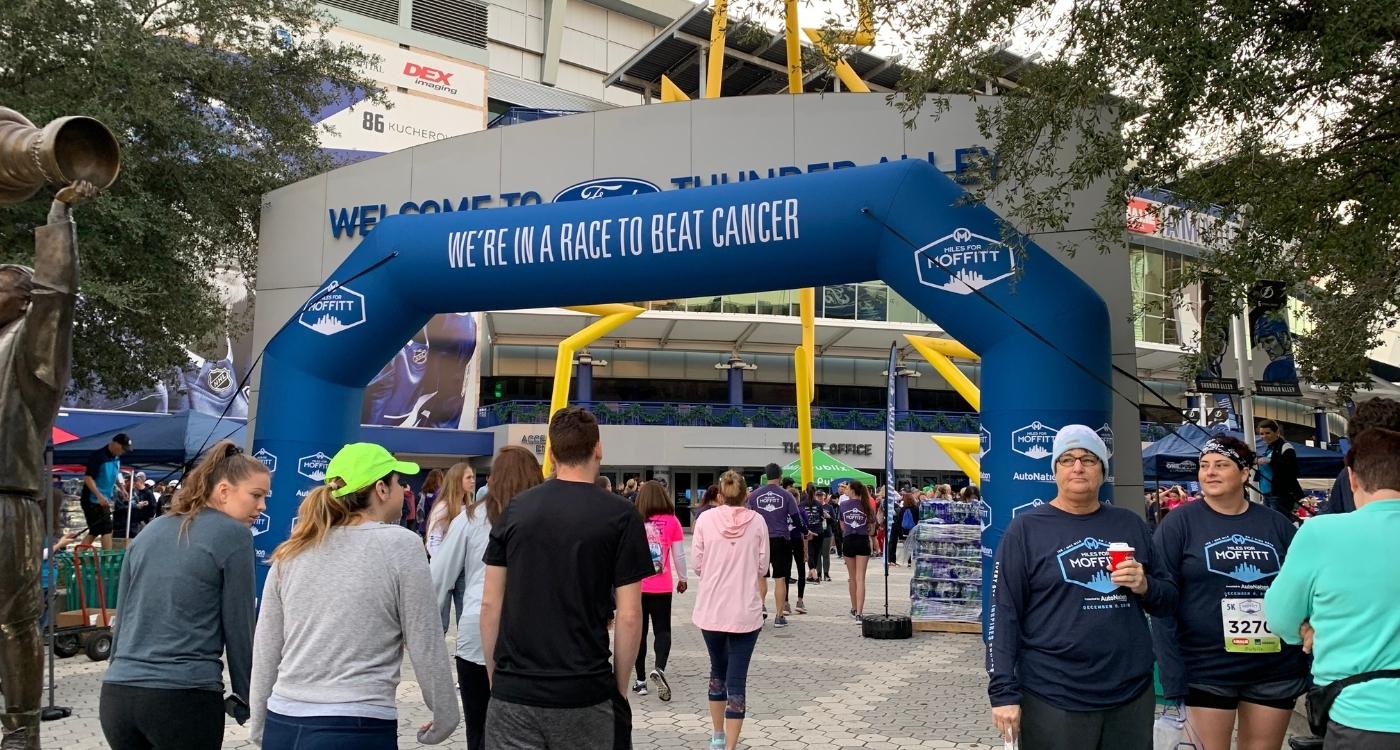
Dye-sublimated graphics on 600D polyester hold color through repeated outdoor deployments. This is what the spec difference looks like in practice.
⚠ Key finding
Listing E discloses dye sublimation at 1440 DPI and detailed blower specs. That information is specific and useful. But buried in secondary product sections are "not weather resistant" and "not for rain or damp conditions." A buyer who reads only the primary spec display will not see this. Selective disclosure creates a false impression of completeness.
What the data shows
Denier is the turning point. It is largely absent in retail and mid tiers. It appears clearly at commercial entry with Listing I's 300D disclosure. It becomes most complete at the spec-complete tier. If a listing does not disclose denier, the vendor has not committed to an engineering standard.
Print method disclosure outpaces material disclosure. Dye sublimation appears in mid-market listings such as Listing E that still hide fabric weight and weather limitations. Seeing "dye sublimation" does not mean the rest of the spec is solid.
Material names without quantification are noise. "Oxford," "Dacron," "PVC," "ripstop polyester" appear throughout the dataset. None are useful without a number. 210D Oxford and 600D Oxford are different products. A PVC claim without thickness specification is not a durability claim.
Warranty signals trust, not transparency. Listing G's 1-year warranty appears before full spec disclosure. It is a commitment indicator, not a substitute for engineering detail.
Performance limitations are buried or absent. Weather restrictions, UV resistance, and outdoor lifespan are absent from the entire dataset except where they appear in secondary sections. No listing quantifies outdoor hours-per-season before wear begins.
Fire safety is easy to overlook. Check for NFPA 701 compliance. Many cheap retail inflatables are not fire-rated, which can get a display rejected by fire marshals at indoor venues and permitted outdoor events.
Six questions to ask any vendor
Use these before you sign off on any custom inflatable quote, whether retail or commercial. A manufacturer who can't answer them probably shouldn't be getting your order.
What is the base fabric material and denier weight?
If the answer is just "polyester" with no number, the vendor hasn't committed to a material standard. "210D Oxford" tells you it's light-use fabric. "600D coated polyester" is a specific claim you can hold them to.
What print method is used?
Dye sublimation embeds the ink into the fabric fibers. Screen print and heat transfer sit on top. That difference shows up within a season of regular outdoor use through cracking, fading, and peeling. If your vendor can't name the method, it's not dye sublimation.
What is the seam construction?
For continuous-air inflatables especially, the seams are where things fail first. Double-stitched and reinforced is the standard you want. If a vendor can't describe their seam construction, ask again.
What are the blower specifications, including wattage and airflow (CFM)?
A 200W and a 650W blower are not the same thing. Underpowered blowers struggle to hold pressure in wind. The spec should be in the listing. If it's not, ask before you order.
What are the actual weather and use limitations?
Ask directly. Can it handle light rain? What wind conditions is it rated for? How many uses before wear shows? None of the listings we reviewed answered these questions unprompted. The commercial-tier vendors could answer them when asked.
What warranty do you offer and what does it cover?
A warranty tied to material grade, such as 3 years on 300D and 5 years on 600D, tells you the manufacturer is confident in the spec. A blanket 1-year warranty with no material disclosure is a customer service gesture, not an engineering commitment.
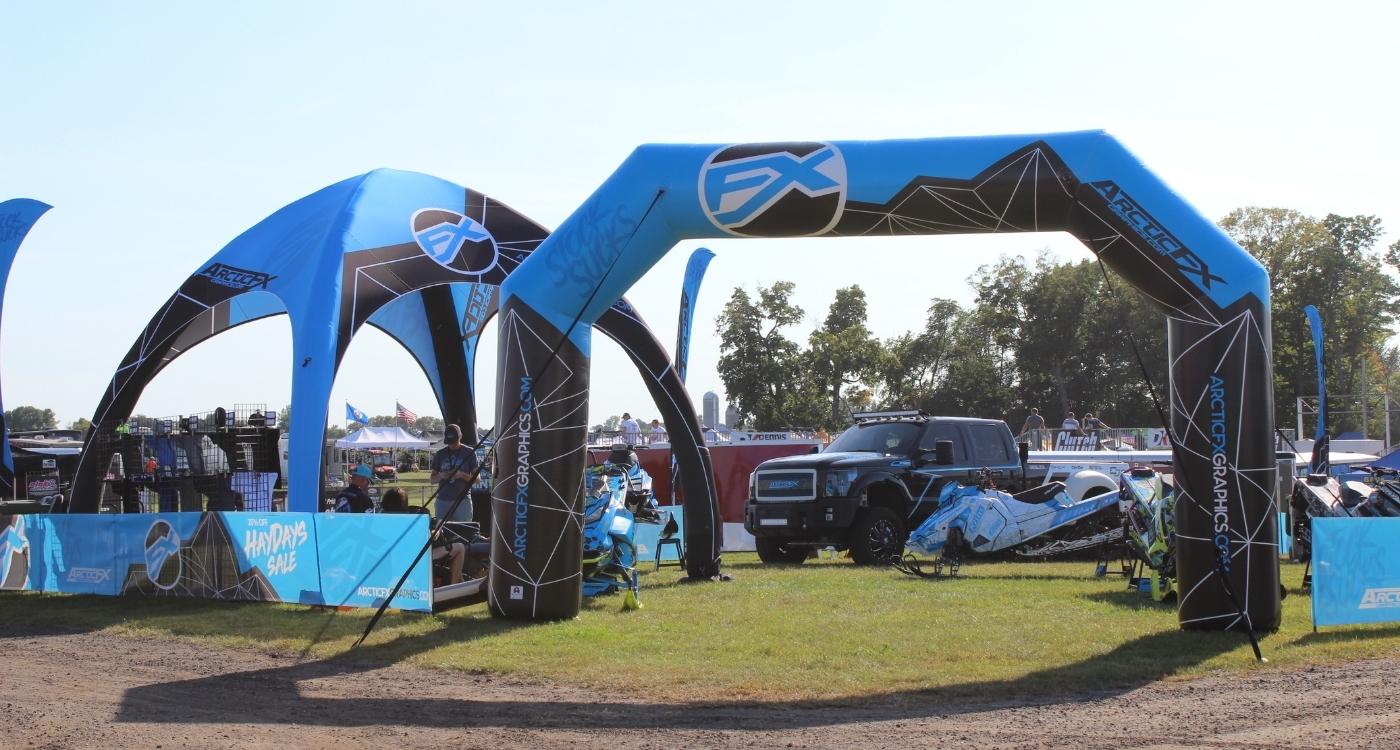
Thirty events per season means this structure earns back its cost per use long before the warranty expires.
The right arch for your program
A 210D Oxford arch handles the occasional indoor event just fine. Run it 30 times a season outdoors and you'll be sourcing a replacement before the year is out. A 600D arch with dye-sublimated printing and a 5-year warranty is built for that kind of use. The upfront cost is higher. The cost per event over five seasons is lower, and you won't be scrambling for a replacement three weeks before your next race.
Ready to spec your inflatable?
MVP Visuals manufactures custom inflatable arches, tunnels, product replicas, and event inflatables for commercial and institutional buyers. Custom quotes typically respond within 24 hours.


